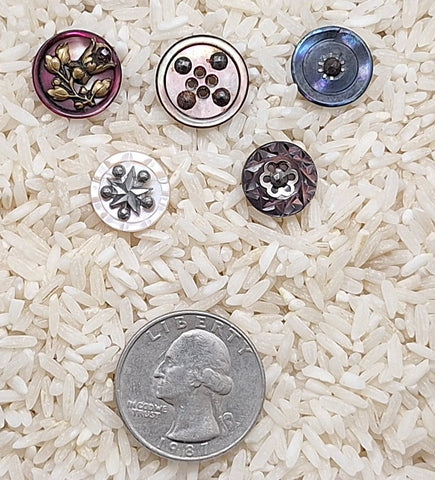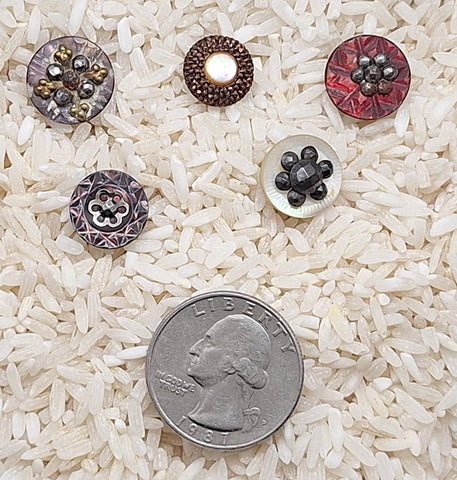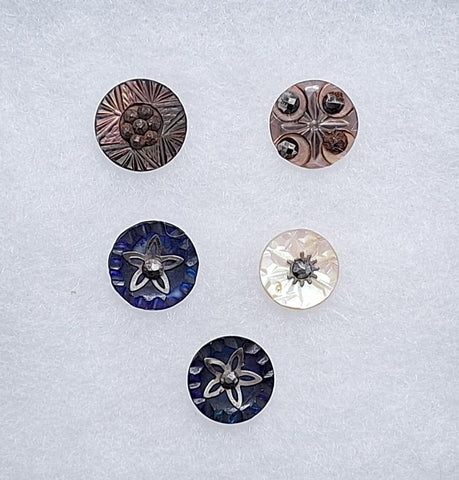

8pc Mixed Antique Metal Military Uniform Buttons Collectable Buttons B725


You are buying the 8 buttons shown in the photo. I admit to knowing nothing about military or uniform buttons. So here is what AI says:
Collectible military and uniform buttons hold a distinct place in militaria and antique collecting. They serve as historical markers for regiments, periods of war, and manufacturing shifts.
Construction & Structural Evolution
Alphaeus H. Albert, author of the primary reference standard Record of American Uniform and Historical Buttons, classifies military uniform buttons into three major construction types:
-
Type I (1-Piece): Predominant in the 18th and early 19th centuries. Cast or molded as a single flat disc of brass, pewter, or tombac, with a wire shank attached or cast directly as part of the piece.
-
Type II (2-Piece): Invented around 1813. Composed of a stamped thin metal face rolled over a flat backplate containing a brazed wire loop/shank. This allowed for hollow, light, highly convex, and intricate 3D repoussé designs (common in Civil War and late 19th-century military issue).
-
Type III (3-Piece): Features a face, backplate, and an additional separate rim piece holding them together. Frequently used for officer staff uniforms and complex post-Civil War military designs.
Historical Significance of Backmarks
The reverse side of a uniform button—the "backmark"—is often more important for dating than the face. Early makers stamped company names, locations, quality ratings (such as "Gilt" or "Extra Quality"), or stars into the backplate.
Key manufacturers sought by collectors include:
-
Scovill Manufacturing Co. (Waterbury, CT): One of the largest suppliers of US military buttons from the War of 1812 through WWII.
-
Waterbury Button Company: Operating continuously since 1812, supplying US uniform buttons for over two centuries.
-
Horstmann Brothers (Philadelphia): Major outfitters and button importers/makers active during the American Civil War.
Key Collecting Categories
-
Branch & Unit Specifics: Early buttons bore letter identifiers on the eagle’s shield—such as "I" for Infantry, "A" for Artillery, "C" for Cavalry, or "D" for Dragoons—making specific branch buttons prized by historical researchers.
-
Civil War (1861–1865): Highly active market segment. Confederate buttons (often imported from British makers like Firmin & Sons due to Southern manufacturing shortages) carry significant collector value.
-
Non-Military Uniforms: Uniform buttons extend to civil service entities like 19th-century railway staff, steamship lines, lighthouse keepers, police, fire brigades, and livery service.